
What Is an AI Employee? A Complete Guide for Modern Businesses
Featured Snippet
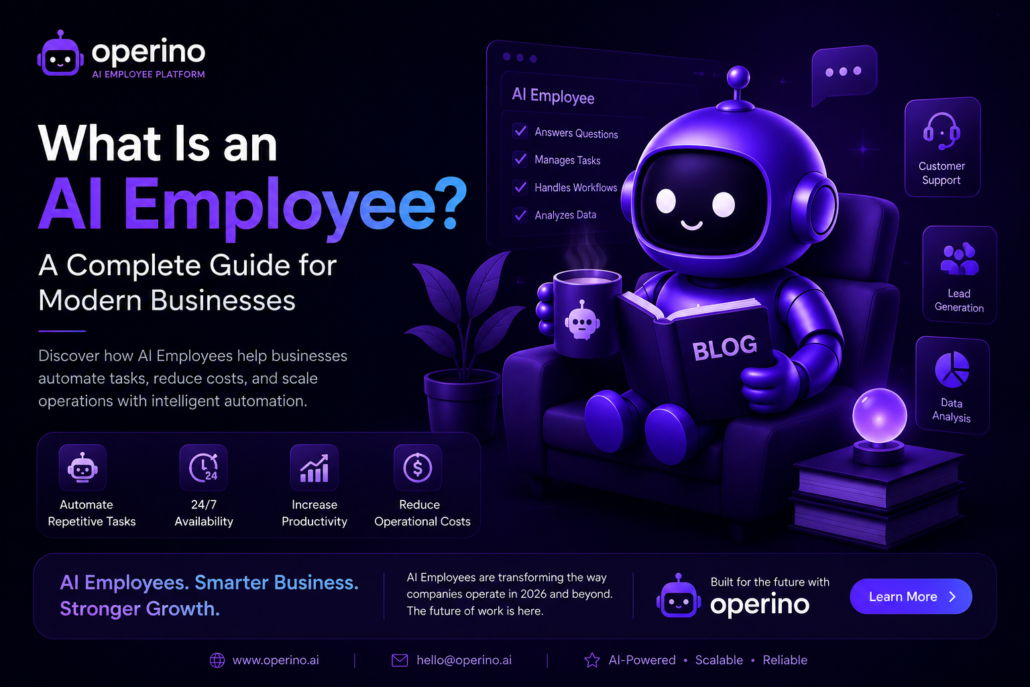
An AI Employee is a virtual AI-powered system designed to perform business tasks such as customer support, scheduling, data processing, sales assistance, and workflow automation without constant human involvement. AI Employees help businesses improve efficiency, reduce operational costs, and scale faster using intelligent automation.
Introduction
The modern workplace is rapidly evolving. Businesses are increasingly turning to automation, artificial intelligence, and digital systems to improve efficiency and remain competitive. One of the most important emerging trends in this transformation is the rise of the AI Employee.
An AI Employee is not just a chatbot or a simple automation tool. It is an intelligent digital workforce solution capable of performing repetitive tasks, assisting teams, automating communication, and supporting business operations around the clock.
From customer support and lead generation to workflow automation and data analysis, AI Employees are changing how companies operate in 2026 and beyond.
As organizations search for smarter ways to reduce costs and improve productivity, AI-powered workforce platforms like Operino are becoming a key part of modern business infrastructure.
What Is an AI Employee?
An AI Employee is an artificial intelligence system designed to simulate specific workplace functions traditionally handled by human employees.
These systems can:
- Answer customer questions
- Schedule meetings
- Automate repetitive workflows
- Manage support tickets
- Analyze data
- Assist sales teams
- Generate reports
- Handle internal operations
Unlike traditional automation software, AI Employees can learn, adapt, process language, and make intelligent decisions based on business logic and user interaction.
Modern AI Employees combine:
- Artificial Intelligence
- Machine Learning
- Natural Language Processing (NLP)
- Automation Systems
- Workflow Integrations
This allows businesses to create scalable digital workforces capable of operating 24/7.
Why Businesses Are Adopting AI Employees
Companies are adopting AI Employees because they help improve productivity while reducing operational pressure on human teams.
1. Cost Reduction
Hiring, training, and maintaining large teams is expensive. AI Employees automate repetitive work and reduce overhead costs.
2. 24/7 Availability
Unlike human employees, AI systems can operate continuously without breaks or downtime.
3. Faster Customer Support
AI-powered support systems can instantly answer customer questions and improve response times.
4. Improved Scalability
Businesses can scale operations faster without rapidly increasing staffing costs.
5. Workflow Automation
AI Employees can automate tasks such as onboarding, notifications, scheduling, reporting, and internal communication.
How AI Employees Work
AI Employees rely on advanced technologies that allow them to process information, understand requests, and execute tasks automatically.
The core technologies include:
Natural Language Processing (NLP)
Allows AI systems to understand and respond to human language.
Machine Learning
Helps AI systems improve performance based on data and interaction history.
API Integrations
Connects AI Employees with CRMs, websites, apps, payment systems, and cloud services.
Automation Engines
Enable task execution based on rules, triggers, and workflows.
Types of AI Employees
Different businesses require different AI workforce solutions.
AI Customer Support Employees
Provide instant support via websites, apps, or messaging systems.
AI Sales Employees
Handle lead qualification, follow-ups, and customer communication.
AI Administrative Employees
Manage schedules, reminders, reports, and internal operations.
AI Marketing Employees
Assist with content generation, campaign automation, and analytics.
AI Operations Employees
Automate business workflows and system management.
AI Employee vs Human Employee
AI Employees are not designed to completely replace human workers. Instead, they help businesses automate repetitive and time-consuming tasks so teams can focus on strategic work.
| AI Employee | Human Employee |
|---|---|
| 24/7 availability | Limited work hours |
| Fast task execution | Human creativity |
| Scalable automation | Emotional intelligence |
| Lower operational costs | Complex decision-making |
| Handles repetitive tasks | Strategic thinking |
The future workplace will likely combine both AI Employees and human teams working together.
Benefits of AI Employees for Modern Businesses
Businesses using AI workforce systems often experience:
- Increased operational efficiency
- Faster customer response times
- Reduced labor costs
- Better workflow consistency
- Improved scalability
- Higher productivity
- Better data processing
These advantages make AI Employees especially valuable for startups, agencies, SaaS businesses, and enterprise organizations.
The Future of AI Workforce Platforms
The AI workforce industry is growing rapidly. Businesses are moving beyond simple automation toward intelligent systems capable of handling complex operations.
Future AI Employees may include:
- Autonomous decision-making
- Voice-based interactions
- AI team collaboration
- Predictive business analytics
- Advanced workflow orchestration
Platforms like Operino are part of this new generation of AI business infrastructure designed to help companies build scalable AI-powered operational systems.
What Is Operino?
Operino is an AI workforce platform focused on helping businesses automate operations, improve productivity, and create scalable digital workflows using AI Employees.
Instead of relying solely on traditional software tools, businesses can use Operino to create intelligent AI-powered systems capable of handling customer communication, automation processes, and operational tasks more efficiently.
As AI adoption continues to grow, platforms like Operino are becoming essential tools for modern digital businesses.
How AI Employees Improve Customer Experience
One of the biggest advantages of AI Employees is the ability to improve customer experience.
Businesses can provide:
- Instant responses
- Faster issue resolution
- Personalized communication
- Automated onboarding
- Better service consistency
Customers increasingly expect immediate support and seamless digital experiences, making AI-powered systems highly valuable.
AI Employee Use Cases
AI Employees can be used across multiple industries:
eCommerce
- Customer support
- Order tracking
- Sales automation
Agencies
- Client onboarding
- Workflow automation
- Lead management
Healthcare
- Appointment scheduling
- Patient communication
Finance
- Reporting automation
- Data processing
SaaS Platforms
- User onboarding
- Knowledge base assistance
How to Implement AI Employees in Your Business
Businesses should approach AI adoption strategically.
Step 1 – Identify Repetitive Tasks
Find processes consuming significant time.
Step 2 – Define Automation Goals
Determine where AI can improve efficiency.
Step 3 – Choose the Right Platform
Select scalable AI infrastructure.
Step 4 – Integrate Existing Systems
Connect CRMs, apps, and workflows.
Step 5 – Optimize and Scale
Continuously improve automation performance.
Final Thoughts
AI Employees are rapidly becoming an essential part of modern business operations. Companies that adopt intelligent automation early will likely gain significant competitive advantages in productivity, customer experience, and operational scalability.
As digital transformation continues to accelerate, AI workforce platforms like Operino are helping businesses move toward smarter, faster, and more efficient operational models.
The future of work is no longer just human or software-based — it is increasingly powered by intelligent AI Employees.
Link this article internally to:

